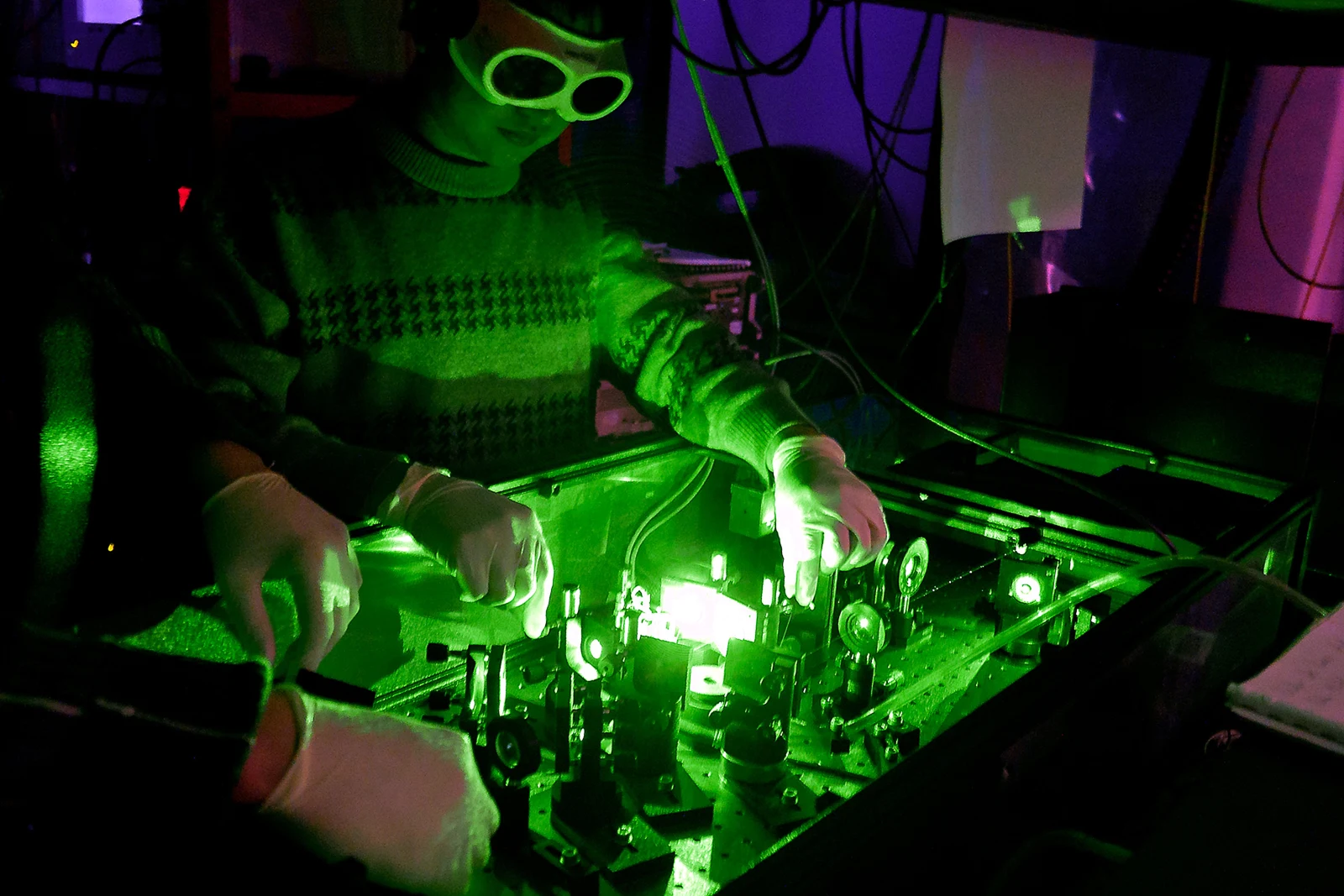
Varennes, Quebec — A research team at the Institut national de la recherche scientifique (INRS) has set a world record in profilometry, capturing three-dimensional images at up to 150,000 frames per second. The technology, called C-BLIP — chromatically band-limited illumination profilometry — was published in Nature Communications by Cheng Jiang and Professor Jinyang Liang of INRS's Énergie Matériaux Télécommunications Research Centre in Varennes, Quebec, and announced by INRS on November 12, 2026. (File image: laser optics research at a university laser physics laboratory.)
C-BLIP works in two modes: continuous colour 3D imaging at 25,000 frames per second, and intensity 3D imaging at up to 150,000 frames per second. With it, the team captured and measured events that happen once and cannot be restaged — a projectile colliding with a turbofan blade at 25,000 frames per second, the aerodynamics of a falling maple samara at 75,000 frames per second, and ultrasonic vibration at the full 150,000, including recovering acoustic information encrypted in a surface's vibrations. The system pairs a digital micromirror device and a custom projection lens on the illumination side with spatially multiplexed colour fringe imaging on the detection side.
Liang, the Canada Research Chair in Ultrafast Computational Imaging, and Jiang, the study's first author, frame the applications across mechanics, aerodynamics, microfluidics, high-speed materials analysis and additive manufacturing — any field where the decisive moment is over before a conventional camera sees it. The work was supported in part by the Natural Sciences and Engineering Research Council of Canada, the Canada Research Chairs Program and Quebec's Fonds de recherche du Québec — Nature et technologies. The paper's stated limit is a restricted field of view in the fastest mode, set by the micromirror device's encoding region.
Why it matters: profilometry — measuring surfaces in 3D — has been speed-limited for decades, which meant the fastest physical events could be simulated but not watched. A 150,000-frame-per-second 3D record turns guesswork about impacts, airflow and vibration into measurement, and it comes out of a Quebec lab.
Sources: Jiang & Liang, "Ultrahigh-speed chromatically band-limited illumination profilometry," Nature Communications, 2026, DOI 10.1038/s41467-026-78478-w (primary source — the 25,000 and 150,000 frames-per-second modes, the three demonstrations and the Varennes affiliation); INRS newsroom, November 12, 2026 (the world-record framing and applications); Phys.org, November 12, 2026, and Technology Networks, November 13, 2026 (independent carries of the record and the demonstration set).