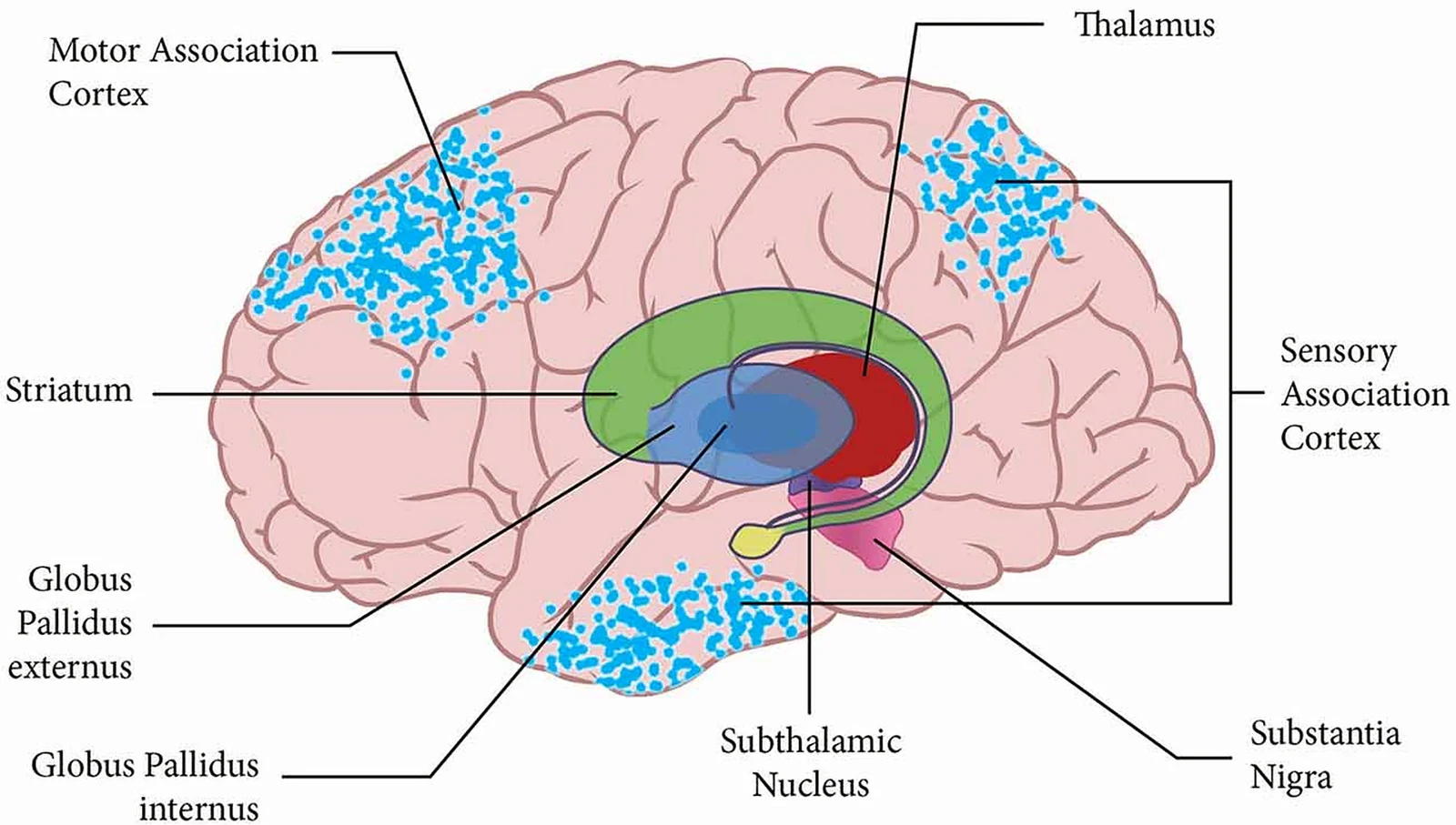
Seattle, Washington — Scientists have produced the first comprehensive cellular atlas of the basal ganglia, the deep-brain system that turns thought into movement and shapes habits, decisions and emotion. The NIH BRAIN Initiative Cell Atlas Network (BICAN) profiled 25.5 million individual cells — 21.0 million from humans, 3.0 million from macaques and 1.5 million from marmosets — and published the work on November 12, 2026, in a package of more than two dozen studies across Cell and its sister journals. The atlas catalogues each cell's identity, gene activity and three-dimensional location, and all of the data is openly available to other researchers. (Image: a cortical surface rendering with the basal ganglia and thalamus overlaid.)
The effort is the first major output of BICAN, the BRAIN Initiative's project to build a complete parts list — an atlas of every cell type in the entire human brain. Dozens of labs and hundreds of scientists across nine countries and more than 50 institutions contributed, using single-cell molecular profiling that measures the genetic expression of individual cells. Reporting on the package describes a shared, cross-species naming system for basal ganglia cell types, early links between specific cell types and conditions including schizophrenia, bipolar disorder and autism, and a reference built from a small number of human donor brains — context that matters for how far the map can be generalized today.
The region was chosen because so much runs through it. Parkinson's disease, Huntington's disease, schizophrenia, bipolar disorder and addiction all carry genetic and molecular ties to the basal ganglia, which makes a cell-by-cell reference for the region a working tool for disease research rather than a curiosity. The researchers and the NIH are explicit about the limit: the atlas is a reference map, not a treatment, and the standardized primate atlas work continues toward a complete human brain atlas targeted later this decade.
Why it matters: modern brain medicine has mostly worked from region-level averages. A public, cell-level map of the brain's movement and habit centre gives every lab studying Parkinson's, Huntington's or addiction the same verified starting grid — the kind of shared infrastructure that quietly speeds up everything built on top of it.
Sources: National Institutes of Health release, November 12, 2026 (primary origin — the BICAN atlas, the 25.5 million-cell breakdown and the open-data release), carried by EIN Presswire, November 12, 2026; the Cell Press study package, November 12, 2026 (the cross-species taxonomy and cell-type findings); National Geographic and Reuters reporting cited in the November 13, 2026 research roundup, and TechTimes, November 13, 2026 (the six-human-brain donor context for the 21 million human cells).