Ukraine struck the bridge linking Russia to annexed Crimea for a second straight day on Tuesday, November 17, 2026, in an attack Kyiv says brought down the crossing's main road arch — and this time, the pictures Kyiv released did not stay unverified for long.
Videos and images posted on X by President Volodymyr Zelenskyy appeared at first to show the bridge's main road arch collapsed into the Kerch Strait, and Reuters said it could not immediately verify the footage. In its later reporting, Reuters said the videos and images it verified showed the main road arch had crumbled into the sea, leaving a yawning gap after two strikes in as many days. BBC Verify reached the same point by its own route: it verified footage filmed from a camera on board a Ukrainian-made Flamingo missile as it approached the main span, and daylight images showing the road arch — about 227 metres long and weighing thousands of tonnes — collapsed into the strait, with roughly 200 metres of roadway below the sea.
What Ukraine says happened is specific. Ukraine's General Staff said the arch and a span of the bridge's road section had collapsed after being dealt powerful blows, but that the rail part of the bridge was still standing, albeit with a damaged arch. The Security Service of Ukraine, the SBU, said one of the metal arches and the road span beneath it were completely destroyed, and that its Alpha special forces fired Palianytsia weapons at the road section before it fell. The General Staff, via the state news agency Ukrinform, said the road section is out of service and no vehicle can cross it.
President Zelenskyy framed the strike as retaliation, and as the end of a long operation. "Russia strikes our infrastructure every day, including bridges," he said in a post on X. "We are … reminding Russia that war will always return to where it began." He said the strike followed an unprecedented operation that methodically destroyed Russian air defences, radar systems and electronic warfare capabilities, and in his nightly address he described a seven-stage operation carried out over several weeks by the SBU and all of Ukraine's forces: Palianytsia drones against the road section, he said, and Neptune missiles together with Ruta and FP-5 drones against the railway section. Those operational details are Zelenskyy's account, attributed to him; no independent source has published a verified inventory of what struck the crossing.
The timeline runs across two days. A significant strike was reported on Monday, November 16, when drones hit the bridge at night: traffic was paused briefly and then reinstated, and although the arch over the road section was visibly damaged, the structure remained standing, BBC Verify reported. In the early hours of Tuesday, November 17, further strikes dealt what Zelenskyy described as the fatal blow to the weakened structure.
Russia's account confirms an attack and a damaged bridge — and disputes almost everything else. Sergei Aksyonov, Crimea's Russian-installed governor, said two people were killed in the strike and traffic across the 19-kilometre (12-mile) road and rail bridge had been suspended. Russia's Transport Ministry, however, said the bridge was damaged in a drone attack and that, on preliminary information, there were no casualties — two Russian official lines that do not agree with each other, and neither of which BIA808 can settle from here. Russia's Investigative Committee said the bridge's structure had been damaged and called the strike a terrorist act. There was no official Russian confirmation of the extent of the damage, Reuters reported. Kremlin spokesman Dmitry Peskov said President Vladimir Putin had been informed, that a repair plan would be prepared, and that the bridge would emerge stronger than before; Deputy Prime Minister Marat Khusnullin chaired a government commission on assessing the damage and organising alternative routes.
On the ground, the railway came back first. Train travel across the bridge resumed on Tuesday after a brief pause, Reuters reported, and Russia's Transport Ministry said rail traffic had resumed on one track, with the first passenger train leaving the Russian side at 1:04 p.m. Moscow time, the business daily Vedomosti reported. Officials advised motorists who wanted to cross the Kerch Strait to use car ferries. BBC Verify noted the parallel rail arch remained standing, although it may also have been damaged — the same qualifier Ukraine's General Staff attached to it.
The wider night was enormous, on Russia's own numbers. Russia's Defence Ministry said it shot down 1,441 drones over 22 regions overnight, surpassing the previous record of 1,336 set on Monday — the ministry's figures, carried here as its claim. In Kyiv the same night, Reuters witnesses reported loud explosions, and Mayor Vitali Klitschko said Russia struck the capital's North and South bridges, an assertion later confirmed by Moscow. Both sides deny deliberately targeting civilians.
The bridge itself is the symbol and the supply line at once: a flagship project inaugurated by Putin in 2018, a year-round emblem of Russia's annexation of Crimea in 2014, and once a key supply route for Russian forces in Ukraine — though the military now relies more heavily on a land corridor through Russian-controlled territory in southern Ukraine, Reuters reported. It also spans the channel commercial vessels use to enter and leave the Sea of Azov, and Andrey Sizov of the consultancy Sovecon told Reuters the collapse could substantially delay any eventual resumption of shipping from the Sea of Azov, because debris would have to be cleared from the channel. On how bad the structural damage is, the sourced assessments split: Colin Capriani, a structural engineer at Monash University, told BBC Verify the damage to the main span is "catastrophic," and Finnish military analyst Emil Kastehelmi wrote that the road bridge won't be repaired during this war — while Moscow's position, via Peskov, is a repair plan and a bridge that comes back stronger.
Why it matters: for the first time in this war, imagery verified by two independent newsrooms shows a whole section of Russia's most defended and most symbolic crossing in the sea — cutting the direct road link to Crimea days before Putin is due to meet the leaders of China and the United States, and doing it, on Kyiv's account, with an operation built over weeks specifically to strip the bridge's defences first. What is not yet known is just as concrete: no official Russian account of the full damage exists, the casualty figures conflict between Russian officials themselves, and until engineers report, the repair clock — months, a year or longer, on the sourced estimates — is an estimate, not a schedule.
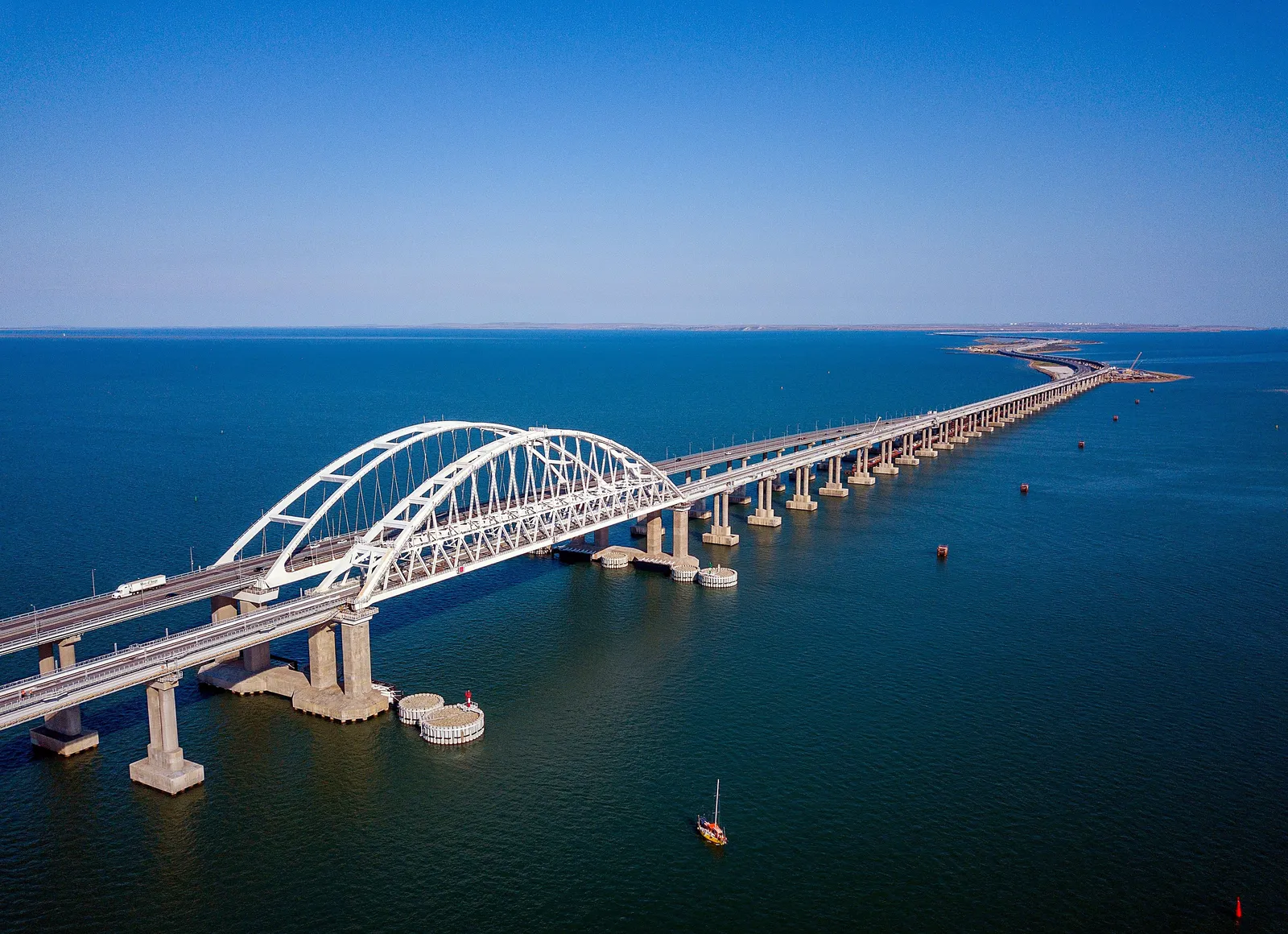
The hero image on this story is a 2019 file photo of the intact bridge. It is not imagery of the November 17 damage.
Sources: Reuters, November 17, 2026 (early and later versions, read in full); BBC News and BBC Verify, November 17, 2026; The Kyiv Independent, November 17, 2026; The Associated Press, November 17, 2026; CNN geolocation and Russian Transport Ministry lines via Military.com, November 17, 2026. Damage extent, casualty figures, drone counts and the operation's design are attributed to their makers above; the collapse imagery is the part Reuters and BBC Verify say they verified.