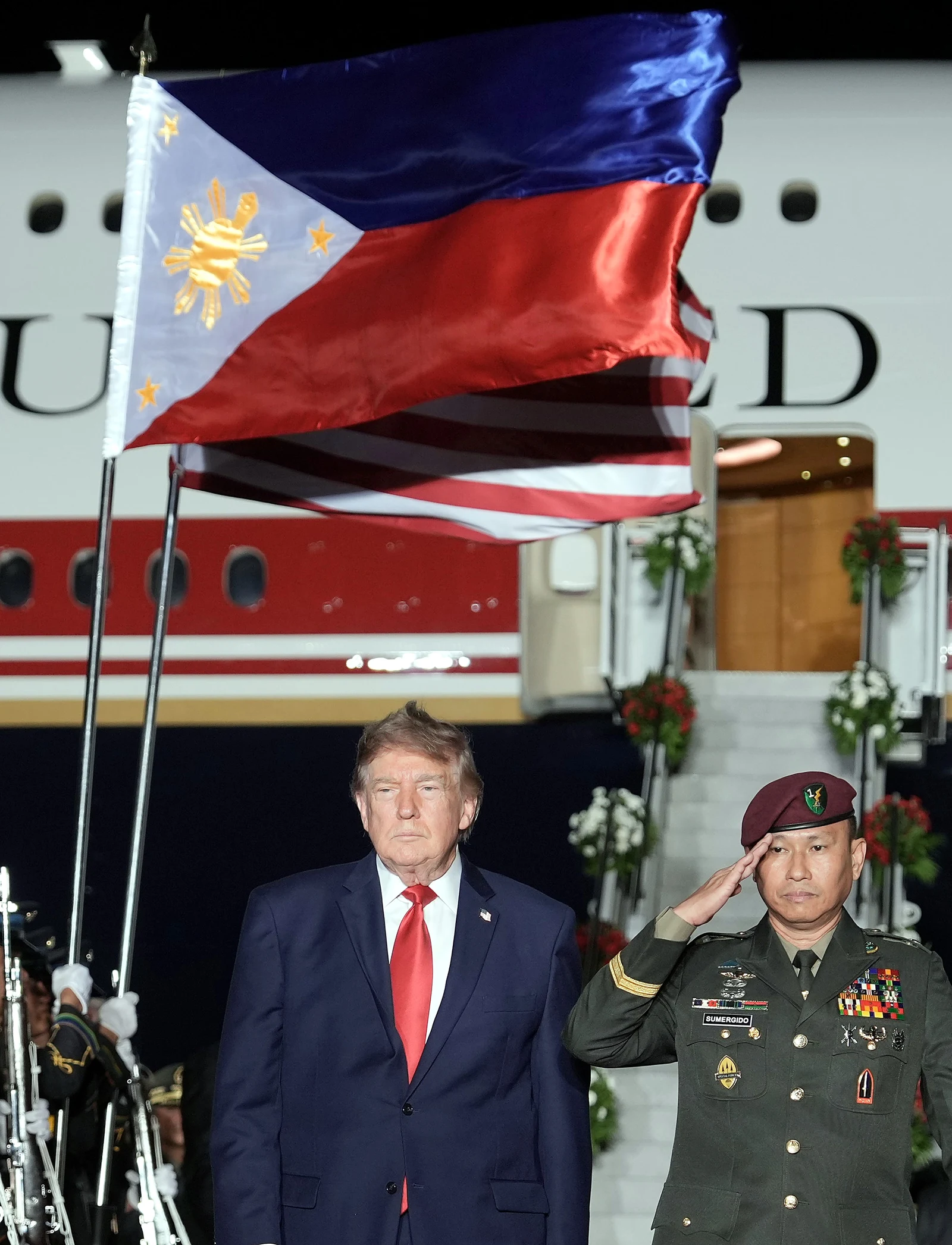
U.S. President Donald Trump arrived in Manila late on Tuesday afternoon, stepping off Air Force One at Ninoy Aquino International Airport to an honor guard, a red carpet and a band playing "YMCA," his signature rally song. Trump pumped his fist as he came down the steps, accepted small American and Philippine flags from a child and twirled briefly to the music before boarding the Marine One helicopter — opening a three-day Asia trip that ends in Shenzhen, China, at the Asia-Pacific Economic Cooperation (APEC) summit.
His first business was the Quad. Trump met the leaders of India, Japan and Australia in the first meeting of the four-country grouping in two years — and his first since returning to the White House. "Our countries are the four corners of a free, open, stable, and prosperous Indo-Pacific," Trump said. In a statement after the meeting, the Quad expressed "grave concerns" about "economic coercion," including arbitrary export restrictions. The statement named no country, but the United States and Japan have complained about China's restrictions on rare-earth exports. The leaders also flagged joint exercises next year with maritime patrol aircraft and an accelerator to fund AI development.
The timing was the message. Former U.S. deputy secretary of state Kurt Campbell credited Secretary of State Marco Rubio with reconvening the Quad — a signature initiative of Trump's predecessor, Joe Biden — now: "This is probably the best possible signal if you're going to go into a trilateral meeting," he said, referring to Thursday's U.S.-China-Russia talks. Xi has previously objected to the Quad as an effort to encircle Beijing; Quad members say it is not directed against any one country.
Trump arrived at the tail end of the 49th ASEAN Summit, the Association of Southeast Asian Nations gathering that ran November 15 to 17 in Manila, and later joined a U.S.-ASEAN "Special Summit" and a gala dinner where he was the guest of honor. China is ASEAN's largest trading partner, but the bloc's biggest economies — a combined GDP of more than $3.9 trillion — want to deepen ties with the U.S. despite protracted trade uncertainty under the Trump administration.
Trade produced the day's one signed document. Trump signed a joint statement with Thai Prime Minister Anutin Charnvirakul on reciprocal trade, saying Thailand would eliminate all tariffs on U.S. exports and remove substantial non-tariff barriers under an agreement expected to be finalized in the coming weeks. The Associated Press reported it covers tariffs on most American goods and $2.6 billion in Thai purchases of U.S. agricultural products.
Not everyone in Manila welcomed the visit. Demonstrators gathered for a fifth day of protests that have included the burning of Trump effigies, calls for an end to the Middle East war and the scrapping of the U.S.-led Pax Silica supply chain initiative. The Associated Press reported about 1,500 left-wing protesters rallied in a downtown square ahead of the arrival, where protest leader Teddy Casiño called on the Marcos administration "to stop being a puppet of Donald Trump and to uphold an independent foreign policy for the Philippines."
On Wednesday, Trump is set to receive a red-carpet welcome and full military honors from Marcos Jr. at Malacañang Palace, followed by a state banquet, before heading to Shenzhen. There, Xi hosts the APEC leaders' meeting on November 18 and 19, and on Thursday, November 19, Trump is scheduled to sit down with Xi and Russian President Vladimir Putin in the first-ever trilateral meeting of the three leaders, with a separate Trump-Xi bilateral also planned — their third meeting in six months. At stake is a fragile trade-war truce that expires in January, now complicated by new U.S. curbs on China's access to advanced AI chips — curbs Beijing calls "economic coercion." What the trilateral will discuss is itself disputed: the White House said Friday that Ukraine would not be on its agenda, while Trump said Monday the leaders would talk about his "favorite subject" of Ukraine. No Shenzhen outcome can be reported yet — none of those meetings has happened.
One more possible meeting is being watched — and it is only a possibility. Reuters reported Tuesday that analysts see the odds of a Trump meeting with North Korean leader Kim Jong Un on the APEC sidelines rising, after Russia's Interfax news agency quoted the Kremlin saying Putin could meet Kim if Kim attended the Shenzhen summit. Trump said on Monday a meeting might happen in China this week, while noting Kim's presence would ultimately be up to Xi as host. "I'm pretty confident something's underway," said Sydney Seiler, a former U.S. national intelligence officer for North Korea now at the Center for Strategic and International Studies. The counterweight is substantial: U.S. and South Korean officials have called the chances low, China's foreign ministry said it had no information on any Kim invitation, and NPR reported the White House is not planning for such a meeting. It is reported and floated — not confirmed.
Why it matters: Manila was the overture, not the main event. By reviving the Quad hours before flying to a summit hosted by Xi — its statement warning against economic coercion while Beijing levels the same charge at Washington — Trump carries allied unity into the most consequential room of his trip. Whether that leverage survives Thursday's first-ever three-way meeting in Shenzhen is the question the rest of the week will answer.