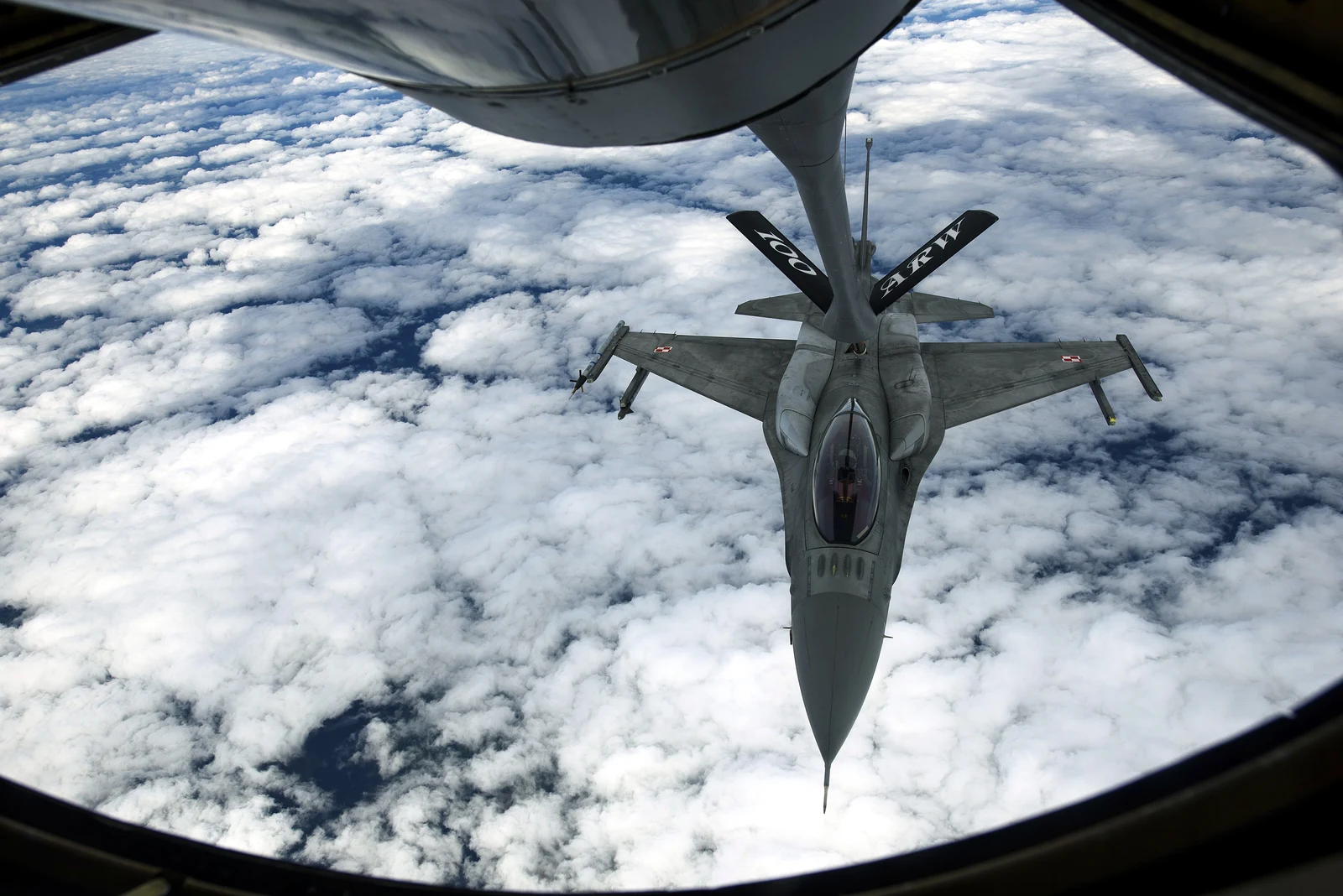
Nowy Lipowiec, Poland — Two Russian missiles and a jet-powered drone came down in southeastern Poland on Friday, November 20, 2026, during a major Russian attack on Ukraine, in the most serious spillover of the war onto NATO territory this year. Poland's defence minister, Władysław Kosiniak-Kamysz, confirmed the airspace violations at a press conference in Warsaw, denouncing what he called a provocation by Moscow. No one in Poland was injured, and no damage to critical infrastructure was reported. (File photo: a Polish Air Force F-16 refuelling from a tanker.)
The three objects fell at three separate locations. At Nowy Lipowiec, in Biłgoraj County in the Lublin region, Kosiniak-Kamysz said the recovered object was a Russian Kh-101 cruise missile. A second object, which he said could also be described as a missile, came down at Rudnik nad Sanem, and the third, most likely a jet-powered drone, at Mołodycz — both in the Podkarpackie region. Interior Minister Marcin Kierwiński said investigations were under way at all three sites, and the Lublin District Prosecutor's Office confirmed that military prosecutors, police and counter-intelligence personnel were examining the crash site at Nowy Lipowiec to establish the object's precise nature and origin.
Poland's military had been on alert from the first warnings at about 1:40 a.m. Polish F-16 fighters and Swedish Gripen aircraft patrolled through the night, supported by an allied refuelling aircraft, and Patriot air-defence systems were activated around Rzeszów-Jasionka Airport — the main hub for Western military aid to Ukraine — and near Świdnik in the Lublin region. The Operational Command of the Polish Armed Forces later said its operation to secure Polish airspace had concluded, that no further violations had been observed, and that air-defence forces had returned to standard activity. Airports in Lublin and Rzeszów resumed flight operations.
Prime Minister Donald Tusk convened an emergency meeting with ministers, military commanders and security officials, and said there was no doubt the objects that landed in Poland were Russian, adding, "It seems we are dealing with an intentional provocation." Kosiniak-Kamysz pointed to the timing: the incursions came as troops from the Coalition of the Willing — the group of Ukraine's allies — were exercising at Nowa Dęba in southeastern Poland, with the defence ministers of France, the United Kingdom and the Baltic states and eight allied chiefs of staff in the country. "These exercises, combined with the presence of defence ministers… suggest that the convergence of these events is no accident," he said. That assessment of Russian intent has not been independently established, and investigators have yet to determine whether the objects entered Polish territory deliberately or as a consequence of their flight paths during the attack on Ukraine. The Russian embassy in Warsaw did not immediately respond to a request for comment, and no Russian government statement on the incident had appeared in the sources checked as of early Saturday.
Warsaw's answer is to ask for more allied steel on its border. Kosiniak-Kamysz said Poland would ask NATO Secretary General Mark Rutte for additional forces and equipment for Operation Eastern Sentry, the alliance's eastern-flank air-defence mission, particularly surveillance aircraft. Rutte posted that he had spoken with Tusk about the "grave violations of Polish airspace" and that NATO jets were scrambled in response, and Tusk said Rutte would visit Warsaw on Saturday, November 21. Eastern Sentry was launched in September 2025, after Russian drones were shot down over Poland and Warsaw requested consultations under Article 4 of the North Atlantic Treaty.
Why it matters: missiles do not have to be aimed at a NATO country to test the alliance — they only have to land in one. Friday's incursions injured no one, but they crossed the line every eastern-flank defence plan is built around, on a day when the alliance's own ministers and generals were exercising a short distance away. What NATO sends to Poland next, and what investigators establish about how the weapons got there, will decide whether this is recorded as a dangerous accident of a massive strike — or as a deliberate probe that demands an answer.