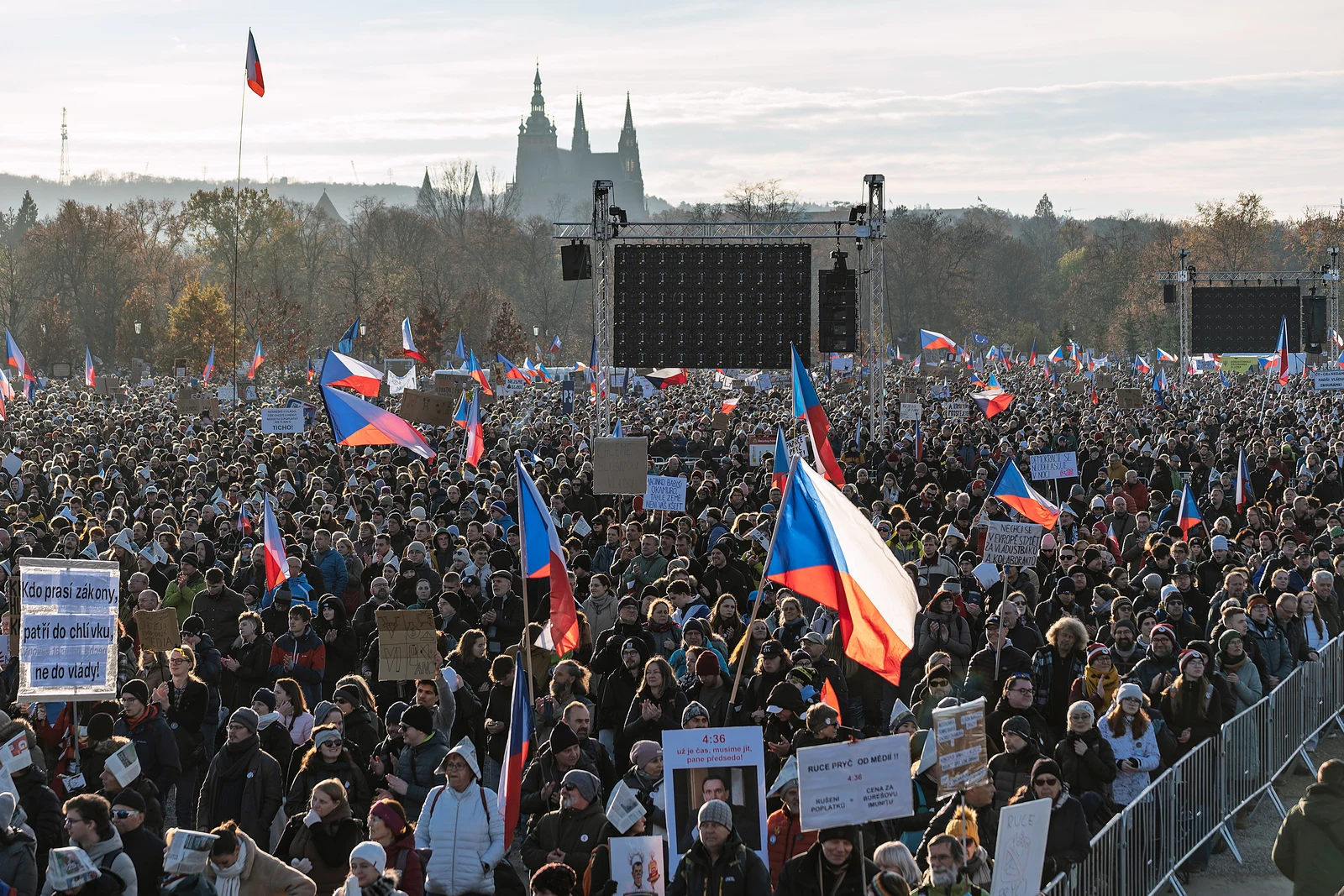
Prague, Czechia — Hundreds of thousands of people filled the Letná Plain overlooking Prague on Sunday, November 15, 2026, in a protest against the government's plan to overhaul how Czech public television and radio are paid for — a funding fight that has become a wider argument about media independence in the country.
The rally, called "Letná Against 4:36," was organised by the civic group Milion Chvilek (Million Moments for Democracy). Its chairman, Mikuláš Minář, estimated some 400,000 people attended; the group's reported estimate ranged from 350,000 to 450,000. That figure is the organisers' estimate, not a verified count: Prague police spokeswoman Eva Kropáčová told the Czech news agency ČTK that police do not publish crowd counts. What is not in dispute is the scale on the ground — the crowd filled the areas set aside on the plain and spread into the adjoining park, clogged nearby metro stations, and, organisers said, exceeded the group's anti-government protest of more than 200,000 people in March. Organisers predicted it could end up as the largest demonstration in the country since the Velvet Revolution of 1989 — a claim that, without an official count, cannot be independently confirmed.
The name is the grievance in miniature. The government's draft bill would cancel the monthly household broadcasting fee — 205 crowns (about $9.26), made up of 150 crowns for television and 55 for radio — that currently funds Czech Television (ČT) and Czech Radio (ČRo), and fund both broadcasters from the state budget instead, with a proposed financing cut of about 15% that critics say would reduce television's nominal budget to its 2008 level and radio's to 2005. The governing coalition pushed the bill through a preliminary vote in the middle of the night in October, fixing the first-reading vote for 4:36 a.m. on October 24. The bill has not passed: it awaits further debate in parliament, and neither the final funding formula nor any safeguards have been settled.
Critics say moving the money into the annual state budget would make the broadcasters dependent on whichever government sets their funding, and opposition parties have compared the plan to changes in Hungary under former Prime Minister Viktor Orbán, who built an array of pro-government media. "An elected government has the right to govern but it does not have the right to do whatever it wants and to dismantle democratic institutions," Minář told the crowd, calling on the government to withdraw the bill and let experts propose genuine safeguards for the broadcasters' independence from political power. Protesters carried signs reading "Hands off the media" and "Let media deal with politicians." Speakers included students, soldiers and former dissidents who signed the Charter 77 initiative, and many in the crowd wore pointed hats folded from newspapers — a tribute to the animated character who has introduced Czech Television's nightly children's bedtime stories for decades. "I know that our entire Czech Television is a guarantee of truth and objectivity," pensioner Milana Rudolfová, 72, told Reuters. "If we do not have public television and radio then unfortunately we will not be able to believe anything anymore." The rally, which police said passed largely peacefully with only minor incidents, came two days before the November 17 public holiday that commemorates the start of the Velvet Revolution, and it followed a one-day strike by Czech Television and Czech Radio workers earlier this month.
The government rejects the protesters' account. The populist government of billionaire Prime Minister Andrej Babiš, backed by the far-right SPD and the eurosceptic Motorists parties, accuses Czech private and public media of bias. Babiš says the bill merely meets a promise to lighten the financial burden on people, insists he will abolish the fees but denies seeking control over editorial decisions, and says he respects the right to demonstrate while disagreeing with the protesters' reasons. He has argued the broadcasters' income from the state budget would be mandatory — set by law, rather than something that could be changed at each annual budget vote. Radek Vondráček, deputy chairman of Babiš's ANO party, dismissed the demonstration before it began, calling the organisers "agitators and professional organizers of demonstrations."
The organisers' next move is already on the calendar: Minář has invited government representatives to a public discussion at Prague's Švanda Theatre at 7 p.m. on December 2, alongside demands that the bill be withdrawn and that Tomio Okamura of the SPD step down as speaker of the lower house.
Why it matters: Letná is the ground where mass rallies helped end Communist rule in 1989, and filling it again — two days before the Velvet Revolution anniversary — turns a technical argument about licence fees into a public test of how much control a government should have over the broadcasters its citizens rely on. The bill is still only partway through parliament, so the fight now moves back to the chamber: the final funding formula, and whether any safeguard written into it can outlast the majority that passed it, will decide what Sunday's crowd actually changed.
Sources: Reuters (Michael Kahn, Prague), Nov. 15, 2026; ČTK (Czech News Agency) reporting, Nov. 15, 2026, including the Prague police statement that no official crowd count is published; Czech domestic reporting via Seznam Zprávy, Nov. 15, 2026. All crowd figures are the organisers' estimates and are attributed as such.
The hero image shows the November 15, 2026 Letná rally in Prague (Skot via Wikimedia Commons, CC BY-SA 4.0).