Pasadena, California — On Wednesday morning, a spacecraft launched when disco was still on the charts crosses a line no human-made object has ever reached.
NASA puts the moment at 5:16:07 a.m. ET on Wednesday, November 18, 2026: Voyager 1 will be one light-day from Earth, approximately 25.902 billion kilometres (16.094 billion miles, or 173.14 astronomical units) away. A light-day is simply how far light travels in 24 hours — which means a radio signal sent from Earth at the speed of light will need a full day to reach the probe, and any answer will need another full day to come back. From Wednesday, every conversation with Voyager 1 is a two-day round trip.
Nothing physical changes at the line. Voyager 1 will not feel a bump, and its surroundings in interstellar space — which it entered in August 2012, the first human-made object to do so — stay exactly as they were. The milestone is about us: the small team at NASA's Jet Propulsion Laboratory in Pasadena, California, which still flies the probe, now works with a full day's delay in each direction.
Voyager 1 was launched on September 5, 1977, and has been travelling ever since — past Jupiter and Saturn, out through the Sun's protective bubble and into the space between the stars, still returning data on a transmitter of about 23 watts. NASA is marking the week publicly: after sunset on Tuesday, November 17, its 'Shine Bright for Voyager' event invites people around the world to point a light at the sky and flash V-G-R, the probe's call sign, in Morse code, and JPL hosts a moderated discussion on Thursday, November 19. Voyager 2, the twin probe, is billions of kilometres closer and is not expected to reach one light-day until around 2035.
Why it matters: one light-day is the cleanest measure yet of how far human engineering has reached — far enough that light itself, the fastest thing there is, needs a whole day to get there. Voyager 1 crossed it still working, still reporting home.
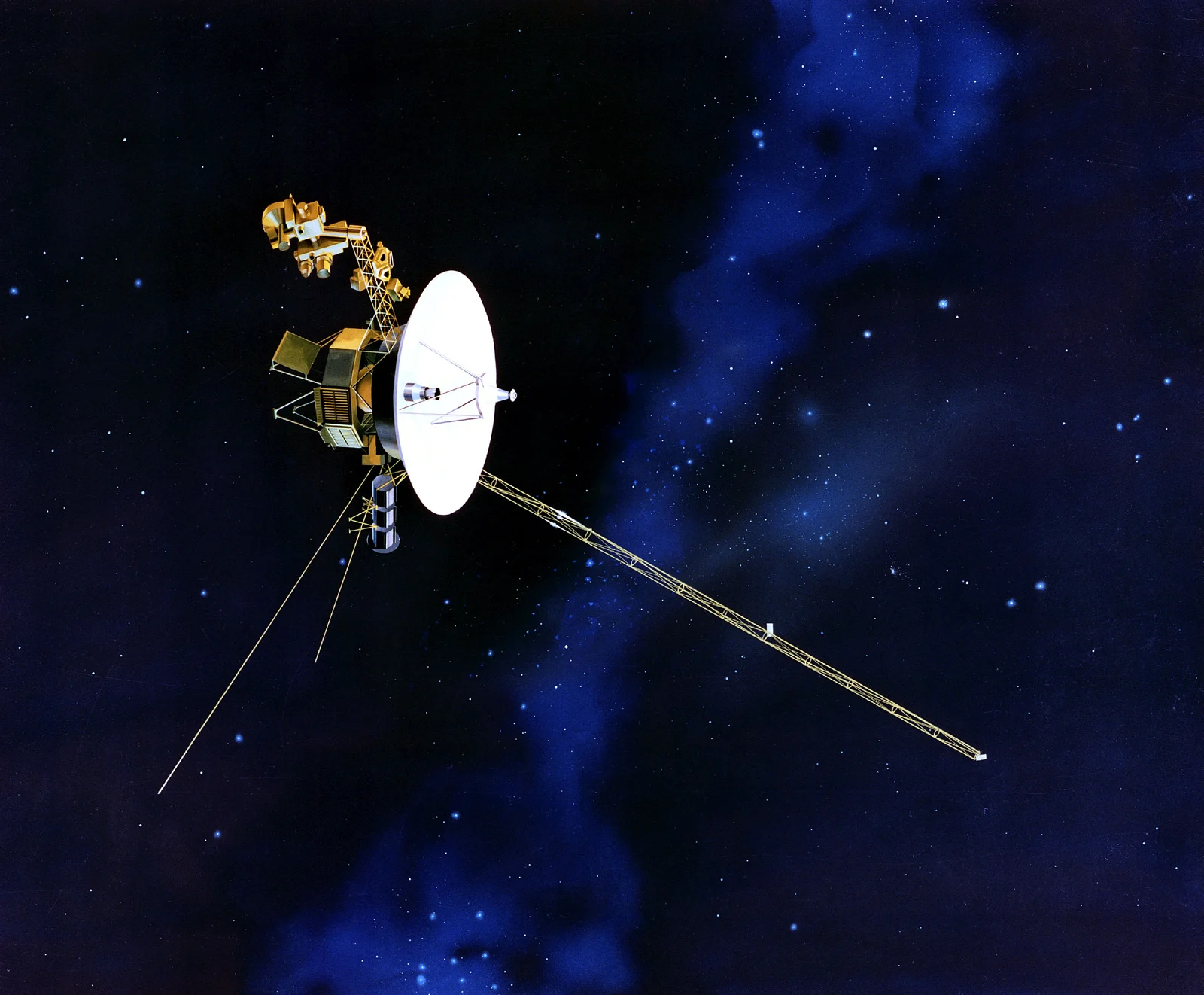
Hero image: an artist's concept of a Voyager spacecraft in space (NASA/JPL, public domain via Wikimedia Commons).