Japan scrambled fighter jets and lodged a very stern protest with Russia after two aircraft believed to be Russian entered Japanese territorial airspace before dawn on Tuesday, November 17, 2026, Japan's Defense Ministry said. The aircraft crossed into airspace over territorial waters northwest of Okinoshima Island in Fukuoka Prefecture, in Japan's southwest, each for about three minutes.
The ministry fixed the sequence to the minute. The first aircraft was inside Japanese airspace from about 4:07 a.m. to 4:10 a.m. local time, and the second from about 4:09 a.m. to 4:12 a.m., Kyodo News and Jiji Press reported from the ministry's account. Air Self-Defense Force fighters scrambled — from the Western Air Defense Force, on the Kyodo account — issued notifications and warnings by radio, and took other measures the ministry did not specify.
Tokyo's language was deliberate on the one point that matters most: the aircraft are suspected, or believed to be, Russian. Japan has not confirmed their identity, and no official account from Tokyo, Seoul or Taipei identified the aircraft types. Nothing in this story states the violation by confirmed Russian aircraft as fact beyond what Japan said — because Japan itself has not said that.
The protest came from the top of the government. Chief Cabinet Secretary Minoru Kihara, the government's chief spokesman, called the violation a serious infringement of Japan's sovereignty and a threat to safety that was completely unacceptable, and said Tokyo had lodged a very stern protest through diplomatic channels and strongly demanded measures to prevent a recurrence, Reuters reported. Defense Minister Shinjiro Koizumi used the same formulation at his own press conference and said the ministry and the Self-Defense Forces would keep Russian military activity under close watch.
After leaving Japanese airspace, the aircraft flew through the Tsushima Strait, between Japan's main island of Kyushu and the Korean Peninsula, then passed between Japan's westernmost island, Yonaguni, and Taiwan, and continued into the Pacific Ocean, the Defense Ministry said. Taiwan's defense ministry separately reported detecting two Russian military aircraft off its east coast the same morning — probably the same aircraft, Reuters reported — monitoring them with joint intelligence and surveillance assets before they exited its air defense identification zone south of Taitung. South Korea's military also scrambled fighters after several Russian aircraft entered the Korea Air Defense Identification Zone over the East Sea; Seoul reported no violation of its sovereign airspace, and its zone entry is a different legal event from Japan's territorial-airspace violation.
The other side has not spoken. As of Tuesday afternoon reporting by Reuters, Kyodo, the Associated Press and the BBC, Russia had not publicly responded to Japan's protest, and no Russian statement confirming or denying the flights had been carried by any source reviewed. The purpose of the flights is likewise unconfirmed: the Defense Ministry said it was still analyzing them, and a Japan Times suggestion that the route may have been a test of Japan's response times is that newspaper's assessment, not an official finding.
The timing carries its own weight. The incursions came ahead of Russian President Vladimir Putin's arrival in Shenzhen, China, for this week's APEC leaders' summit, which Japan's Prime Minister Sanae Takaichi is also expected to attend, and against already-soured bilateral ties. It was the first confirmed violation of Japanese airspace by Russian aircraft since September 23, 2024, when a Russian aircraft entered airspace north of Rebun Island, off Hokkaido, the ministry said.
Why it matters: foreign military aircraft almost never enter Japanese territorial airspace — as opposed to the wider identification zones planes cross routinely — and Tokyo is treating three minutes over Okinoshima as a sovereignty event, not a navigation error. Until Moscow answers, what is settled is Japan's account, carried identically by its own ministry and every wire that reported it: two entries, five minutes, a scramble, and a protest with no reply.
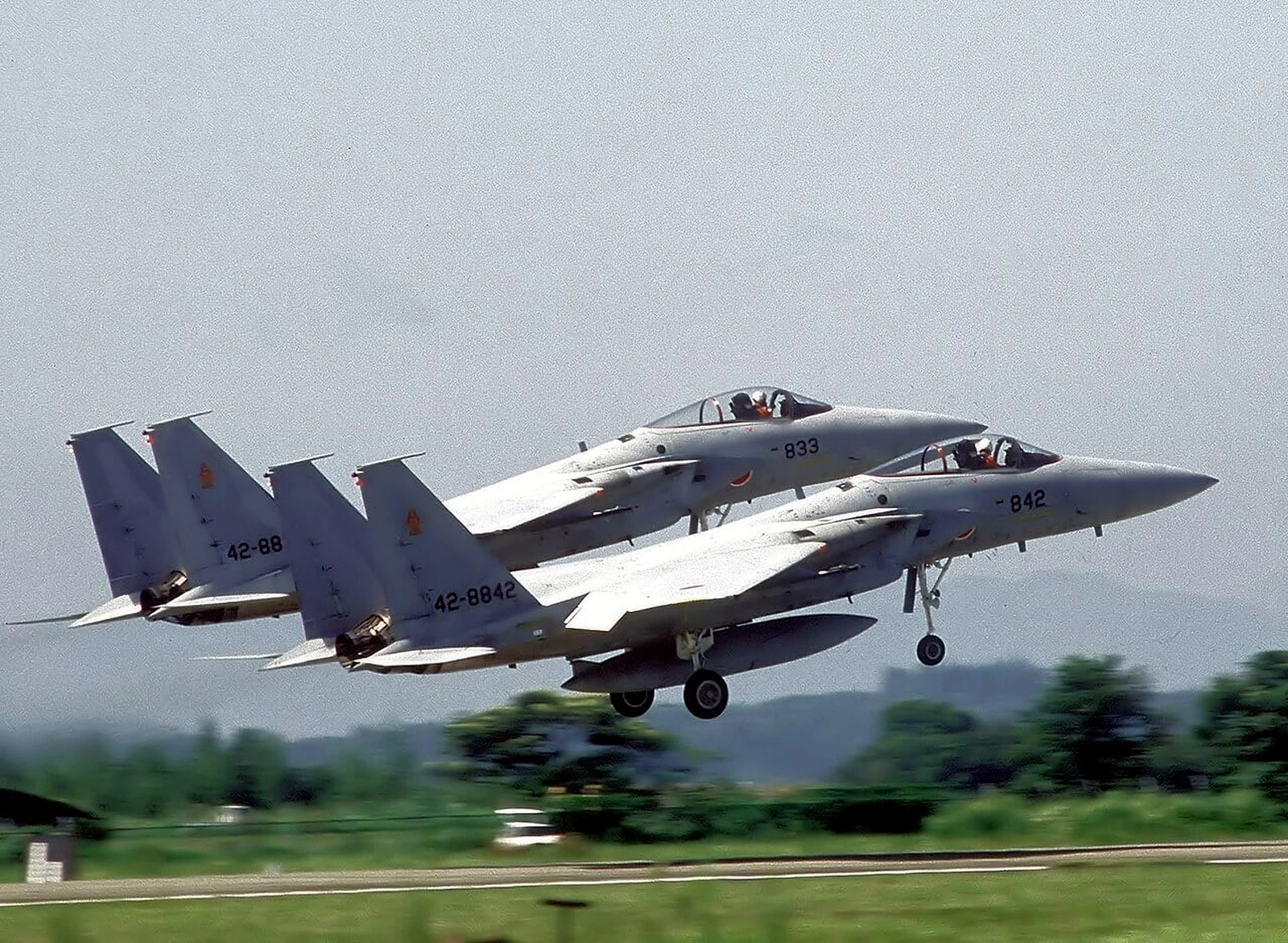
Sources: Japan Defense Ministry statement of November 17, 2026 (primary), as reported by Kyodo News and Jiji Press; Reuters, November 17, 2026 (Ben Blanchard and Kaori Kaneko, Taipei/Tokyo); the Associated Press and BBC reporting of the same statements. Aircraft identity is attributed to Japan as suspected throughout; Russia had not publicly responded at the time of reporting. Photo: SSgt. James R. Ferguson / U.S. Air Force (public domain) — file photo of two Japan Air Self-Defense Force F-15J Eagles of the 202nd Tactical Fighter Squadron taking off from Nyutabaru Air Base, Kyushu, in 1985. Japan did not say which fighters scrambled on November 17, 2026.