Amazon's satellite internet program has lost a full launch. A United Launch Alliance (ULA) Vulcan rocket carrying 40 satellites for Amazon Leo — the network formerly known as Project Kuiper — lifted off from Space Launch Complex-41 at Cape Canaveral Space Force Station in Florida at 12:40 p.m. EST on Sunday, November 15, 2026, and failed about 10 minutes into the flight. None of the 40 satellites reached orbit.
ULA, the Boeing–Lockheed Martin joint venture that operates Vulcan, confirmed the loss in a statement issued about 50 minutes after liftoff: "Based on data received by our Launch Director, we confirm that the Vulcan vehicle launched from Space Launch Complex 41 suffered an anomaly 10 minutes into the flight and failed to deliver the Amazon mission to orbit." The company said it will work closely with its customer and other appropriate organizations to find the cause, determine corrective action and return to flight as quickly as possible — and conceded, in a second line carried by GeekWire: "Today, we did not meet that standard."
What happened in the air
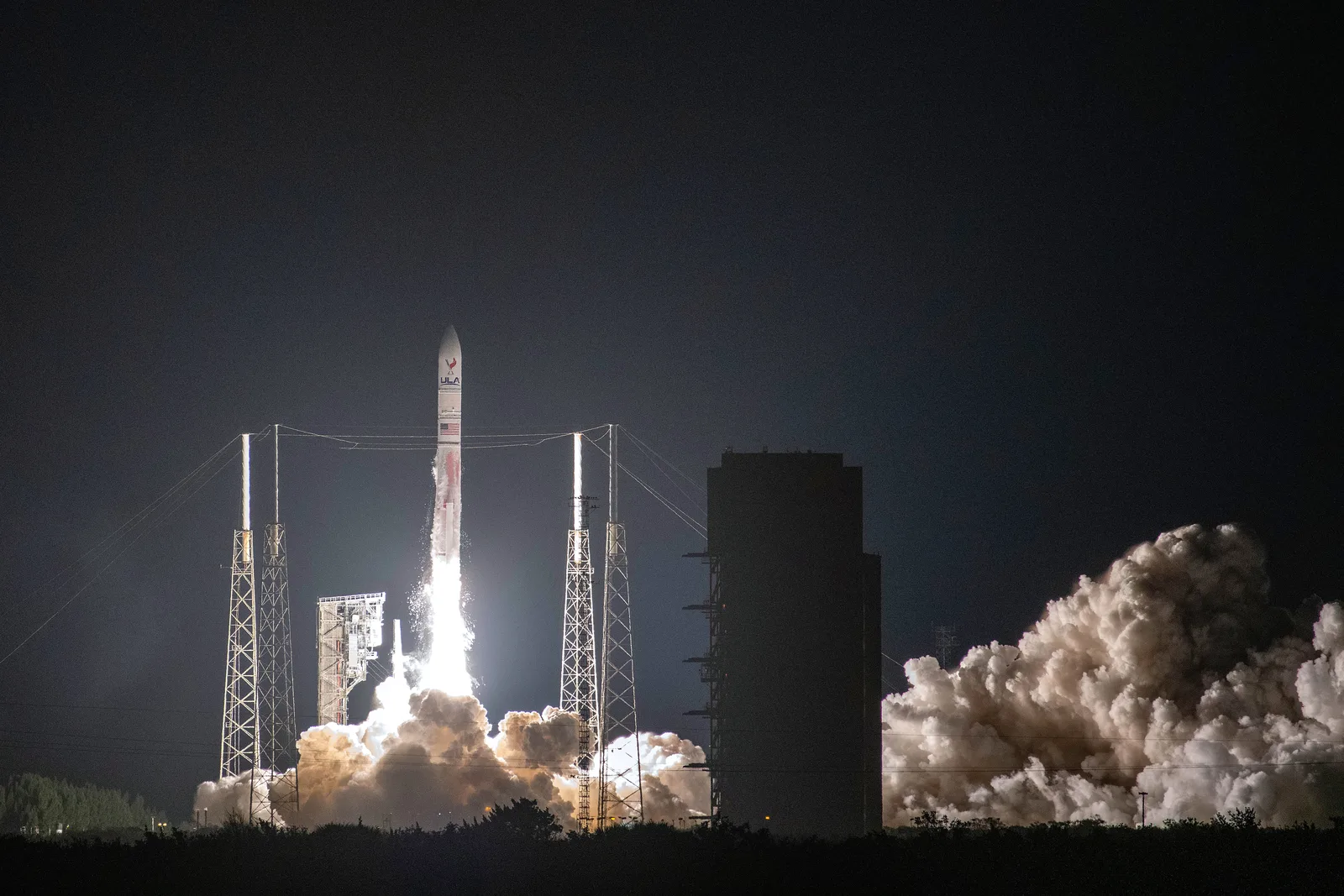
The mission, designated LV-01 (Leo Vulcan 1), was Vulcan's fifth flight since its January 2024 debut, its first flight in nine months, and the first of 38 Vulcan launches Amazon has purchased for Leo. The 214-foot rocket flew in its heaviest configuration, with six Northrop Grumman solid rocket boosters and two Blue Origin BE-4 engines producing 3.8 million pounds of thrust.
Sunday's liftoff came after a difficult countdown weekend: a Friday attempt was scrubbed when a gaseous nitrogen plant serving multiple launch providers failed, a Saturday attempt was called off over network problems between the rocket and ground systems, and on Sunday controllers held the count at T-minus 20 seconds for a technical issue before the rocket finally launched at the end of its window. It is not known whether that issue played any role in what followed.
The solid boosters — whose nozzle failures marred two earlier Vulcan flights and grounded the rocket after February — appeared to perform normally this time, burning out and separating roughly a minute and 40 seconds into the flight, according to Spaceflight Now. The failure came later, during the burn of the hydrogen-fuelled Centaur upper stage that was to carry the satellites the rest of the way to orbit. Spaceflight Now reported that the first stage appeared to burn longer than ULA's pre-launch timeline called for and that the Centaur made unusual orientation adjustments early in its burn. ULA has not identified a cause, saying it does not yet have the specific data to explain what went wrong; the answer will come from the flight telemetry investigation, and Vulcan is expected to stand down while it runs. NASA Administrator Jared Isaacman publicly offered the agency's help with the investigation.
The cost to Amazon Leo
The 40 satellites were the largest single batch Amazon has ever launched for the constellation — every previous Leo mission carried between 24 and 36 satellites. Amazon had launched nearly 400 Leo satellites across 14 missions since full-scale deployment began in April 2025, and Vulcan was slated to carry more than 1,500 of the constellation's 3,232 first-generation satellites, more than any other rocket in the program. Amazon renamed the program from Project Kuiper to Amazon Leo on November 13, 2025; it is being built to compete with SpaceX's Starlink, and Amazon faces a July 30, 2029 deadline to deploy and operate the full first-generation constellation.
Amazon's own response was measured. In a statement added to its official mission log, the company said: "There is risk with any launch, and that's especially true for inaugural missions like LV-01. ULA has been a trusted partner for Amazon, and we believe they'll learn from this mission and deliver on their long-term plans for Vulcan."
The loss is also a first for the launch provider: Spaceflight Now and Reuters both report it is the first outright mission failure of a ULA rocket since Boeing and Lockheed Martin formed the company in 2006.
What happens next
Vulcan's next Leo flight now waits on the investigation — Amazon had said a second Vulcan mission could fly within weeks of the first. The program itself does not stop: Amazon's next scheduled Leo launch is mission LE-04, an Arianespace Ariane 6 (Ariane 64) carrying 36 satellites from the Guiana Space Centre in Kourou, French Guiana, targeted for no earlier than Monday, November 23, 2026. On a successful deployment it would be Arianespace's fourth Leo mission of the year.
Why it matters: Amazon is racing a regulatory clock and a dominant rival with a constellation that is still only about an eighth built. Losing its biggest batch yet — on the debut flight of the rocket meant to be the program's workhorse, flown by a provider that had never outright lost a mission in 20 years — turns a deployment schedule that was already tight into an investigation timeline nobody controls.
Sources: Amazon Leo official mission log (About Amazon, updated Nov 15, 2026); United Launch Alliance statement, Nov 15, 2026; Spaceflight Now, Nov 15, 2026; Reuters (Joey Roulette), Nov 15, 2026; GeekWire, Nov 15, 2026.
Hero photo: a ULA Vulcan rocket launching from Space Launch Complex-41 at Cape Canaveral on its first certification flight in January 2024 (file photo via Wikimedia Commons).