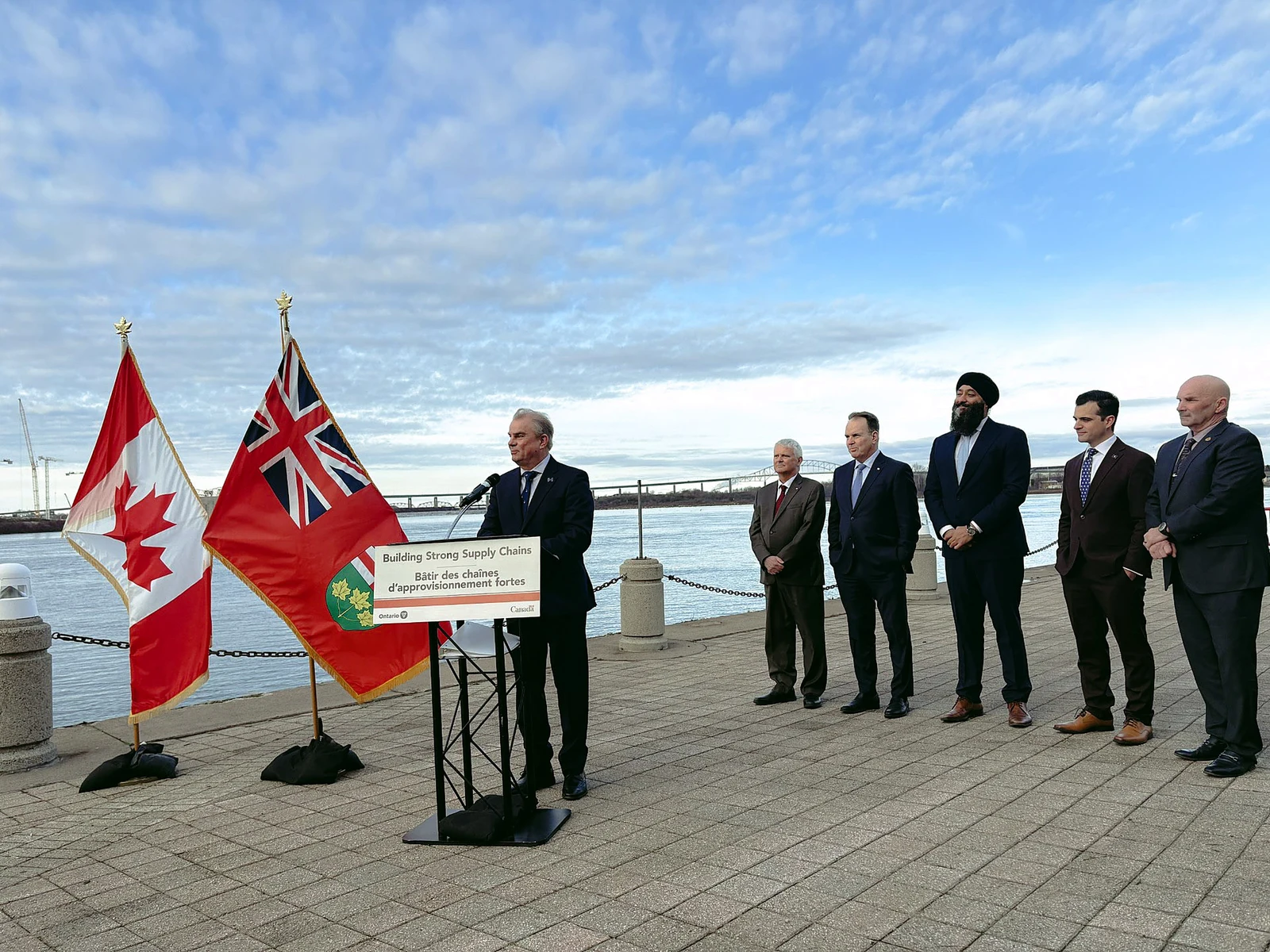
The announcement was made in Sault Ste. Marie on Friday morning, with the federal Transport Canada media advisory setting the event for 9:00 a.m. Eastern Standard Time. Federal Transport Minister Steven MacKinnon announced an investment of up to $125 million through the Trade Diversification Corridors Fund, and Ontario Transportation Minister Prabmeet Sarkaria announced the province's intention to provide a $125-million loan. The project is led by the Hamilton-Oshawa Port Authority (HOPA Ports) in partnership with the City of Sault Ste. Marie, and the city has separately approved up to $15 million toward the project.
The port will be built on approximately 243 acres (98 hectares) of industrial and brownfield land. Transport Canada says the work includes construction of the new multimodal port itself, two seaway-draft marine berths, a rail transload yard and supporting transportation infrastructure, plus roads, utilities, storage and laydown areas and tenant-ready industrial lands. Ottawa describes it as the region's first public, multi-user marine port between Thunder Bay and Southern Ontario, closing a trade-infrastructure gap in Northern Ontario and connecting the region to Southern Ontario ports and the Great Lakes–St. Lawrence Seaway system.
Once fully operational, the port is expected to increase cargo-handling capacity to more than 3.5 million metric tonnes annually by 2031 — a three-fold increase over current volumes, according to Transport Canada. HOPA Ports projects the port will handle more than 2.4 million metric tonnes of cargo a year once operational, moving agricultural products, mining and critical minerals, forestry products and manufactured goods to markets across Canada and internationally, including Europe. Ontario's release adds that the port will support mining, steelmaking and critical mineral development in Northern Ontario, including the Ring of Fire region.
The jobs case is a large part of the pitch. Transport Canada projects 2,150 direct and 2,600 indirect jobs from the project. HOPA Ports estimates about 1,270 jobs during the engineering and construction phase, with port-enabled activity projected to sustain up to 4,750 direct and indirect jobs annually as operations expand and generate approximately $933 million in annual GDP.
Nothing about the build is immediate, and the governments' own timeline says so. Work in 2027 will focus on land arrangements, Indigenous partnerships, environmental and technical investigations, regulatory review and detailed design. Subject to approvals, site preparation could begin in 2028, followed by major marine, road, rail and utility construction in 2029. Full buildout is targeted for 2031.
The political framing is trade diversification. "With U.S. tariffs threatening Canadian jobs and industries, there has never been a more important time to build for the future and invest in infrastructure that will help Canadian businesses diversify," Premier Doug Ford said in the federal release. MacKinnon said the project "will create new trade opportunities, support economic growth across Northern Ontario, and reinforce Canada's position as a reliable and competitive trading nation." HOPA Ports President and CEO Ian Hamilton called it "one of the most significant investments in Great Lakes maritime infrastructure we've seen in our lifetimes," and Sault Ste. Marie Mayor Matthew Shoemaker said economic diversification "has been the most pressing challenge facing Sault Ste. Marie" for decades and called the port a breakthrough.
The caveats are on the record too: Ontario's $125 million is a repayable loan the province has stated its intention to provide, not a grant already paid; the federal contribution is an investment of up to $125 million through a fund introduced in Budget 2025; and the 2028 site-preparation start depends on approvals that have not yet been granted. Local industry quoted in the announcement — including Purvis Marine, Tenaris's Sault Ste. Marie Industrial Centre and Inter Ontario Equipment — backed the port as a route to more affordable transportation and room to expand.
Why it matters: Sault Ste. Marie sits at the heart of the Great Lakes, between Lakes Superior and Huron, but Northern Ontario's resource economy has had no public, multi-user marine port of its own between Thunder Bay and Southern Ontario. A working port there gives mining, steel, forestry and farm producers a marine-and-rail route to southern manufacturers and overseas markets that does not depend on long truck hauls or U.S. routes.
Sources: Transport Canada (Government of Canada), "The Government of Canada, together with the Province of Ontario, invests in strengthening trade capacity and supply chain resilience through the Port of Sault Ste. Marie" (Nov. 20, 2026) and Transport Canada media advisory (Nov. 19–20, 2026, via CNW); HOPA Ports and the City of Sault Ste. Marie, "Federal and Provincial governments announce $250 million to build new Port of Sault Ste. Marie" (GlobeNewswire, Nov. 20, 2026); The Canadian Press, "Ontario, Ottawa committing $250 million to help fund new port in Sault Ste. Marie" (Nov. 20, 2026).