Toronto, Ontario — Ontario's English Catholic teachers have handed their union one of the strongest strike mandates in the province's education sector. The Ontario English Catholic Teachers' Association (OECTA) announced on Monday, November 16, 2026, that 98 per cent of those voting in its province-wide all-member strike vote, held November 12 and 13, voted in favour of authorizing strike action if necessary. The Canadian Press reported the same result the same day.
OECTA represents 45,000 teachers in Ontario's publicly funded English Catholic schools, from Kindergarten to Grade 12. The size of the number is the message: this was not a divided membership giving its bargaining team a tool, it was a near-unanimous instruction.
'Catholic teachers have spoken with one clear, united voice,' OECTA President René Jansen in de Wal said in the union's release, adding that the mandate sends 'an unmistakable message to the government: the time for meaningful action at the bargaining table is now.'
What the vote does not do is start a strike. The union stressed that point in the same release: 'A strike vote does not mean Catholic teachers will take job action, and OECTA is not in a legal strike position at this time.' No strike date has been set, no job action has been called, and a lawful strike in Ontario education still requires further steps, including conciliation and notice. Jansen in de Wal said the union's priority 'remains exactly where it has always been: at the bargaining table, negotiating a fair agreement.'
The backdrop is a bargaining round that has barely begun. The collective agreements covering Ontario's five main education unions, OECTA included, expired on August 31, 2026. Talks have been stalled over which issues belong at the central provincial table and which belong at local board tables, a dispute waiting on an Ontario Labour Relations Board decision. OECTA says its calls to start negotiations early, back in March, and to meet more frequently were ignored, and that Education Minister Paul Calandra declined to return to the table until the board rules — an allegation the union makes in its release and the government has not answered in response to Monday's result.
The union's stated grievances are familiar across the sector: what it calls chronic underfunding, overcrowded classrooms, staffing shortages and escalating violence in schools. Those are OECTA's claims, presented as its case for a better deal, not independent findings.
The other side had not published a response to the 98 per cent result by Monday evening. The government's most recent on-record position on the education unions' strike votes came in September, when a spokesperson for the minister called the votes premature, said the labour-board process had delayed the start of bargaining, and said the province would be ready to negotiate once that process concluded, with its focus on reaching a deal that keeps students in class.
OECTA is one of five Ontario education unions that scheduled strike votes between November 4 and 18, so its result lands in the middle of a sector-wide pressure campaign, not on its own.
Why it matters: a 98 per cent mandate does not close a single school tomorrow, but it changes the math at Queen's Park. The government now negotiates with a union that can credibly say its members have already voted, almost unanimously, to walk if the table fails. The share trigger is the gap between the two numbers in this story: 98 per cent ready to strike, and zero days of job action called — all of the leverage, none of it spent yet.
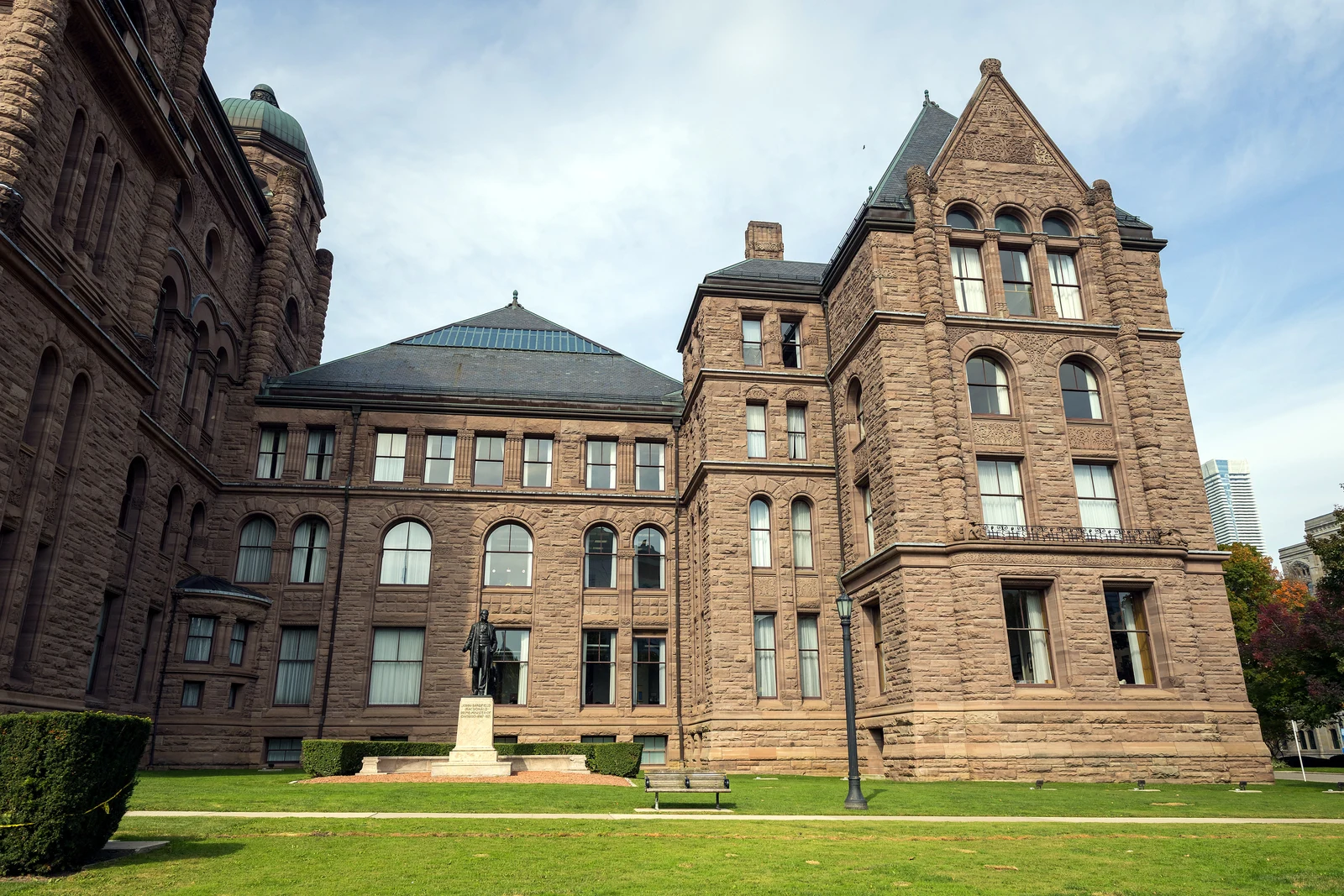
Photo: The Ontario Legislative Building at Queen's Park in Toronto (file photo, October 2026).